
Following the water down
Window Moss Removal in Parksville, Head to Sill
Rain runs down a window from the trim above it to the drain slots below, and moss settles wherever that water slows. We clear each stop on the way, by hand.
Customer reviews
What customers say
Great experience working with this company! Quick turn around time and very professional. I’ll definitely be using their services again in the future.
Great job and fair pricing! Will hire again!
The service provided by the owners of the company and the staff were beyond exceptional. The price was also very exceptable and affordable.
Why us
Why customers love our service
And why you will get the best moss removal service in Parksville!
Fast and efficient moss removal
We arrive on the agreed day, finish every slope we quoted for, and leave the yard as tidy as we found it.
Clear and quick communication
Calls and texts get answered, the price is settled before work begins, and afterwards we tell you how the roof looked.
Five-star reviews
Homeowners rate our crew five stars, review after review.
Clearing moss since 2021
Five years on Oceanside roofs of every kind: asphalt, cedar, tile and metal, plus the paving beneath them.
- Every window and glass door checked from outside, upper storeys too
- Drip caps and head trim cleared of needles, grit and moss
- Tracks emptied and wiped, screens lifted out and put back
- Weep slots opened and each channel pour-tested
- Run-off stripes on siding under the sills washed at low pressure
- Nothing aimed at a seal or a glass edge with higher pressure
- Debris bagged and removed, decks and beds below swept
Watch one window through a wet Oceanside winter and you can trace the whole problem from top to bottom. Rain drips off the eave onto the trim over the opening, slides down the glass, collects along the bottom of the frame and is meant to leave through two or three small slots on the outside face. Moss appears at each point on that route where the water slows down and the sun never reaches. We work each window in the order the water travels.
Above the glass: the head of the window
Most wood-frame houses have a strip of flashing or a drip cap over each window, there to throw rain clear of the opening. Under a shallow eave that little ledge catches fir needles, maple seed keys and grit washed off the shingles, and moss roots into the pile. Once it does, the edge stops shedding water. Rain creeps back along the underside instead and into the joint between the head trim and the frame, a joint that sits above eye level where nobody checks it.
We pick the ledge clean along its full width and make sure the drip edge is open again. If moss on the roof above is washing down onto your window heads with every storm, the frames will not stay tidy for long, and roof moss removal is the job to sort first.
At the edge of the glass
Glass itself sheds water well, which is why moss rarely grows on it. The edges are another matter. A thin strip called the glazing bead or stop holds the sealed unit in the frame, and the hairline gap along its lower edge fills with a line of dirt that greens over by midwinter. That line sits right where a double-glazed unit’s edge seal is closest to the weather. We brush it out with a soft brush and keep the rinse at low pressure there, because driving water past that bead is how a clear unit begins to fog.
The bottom of the frame: track and weep slots
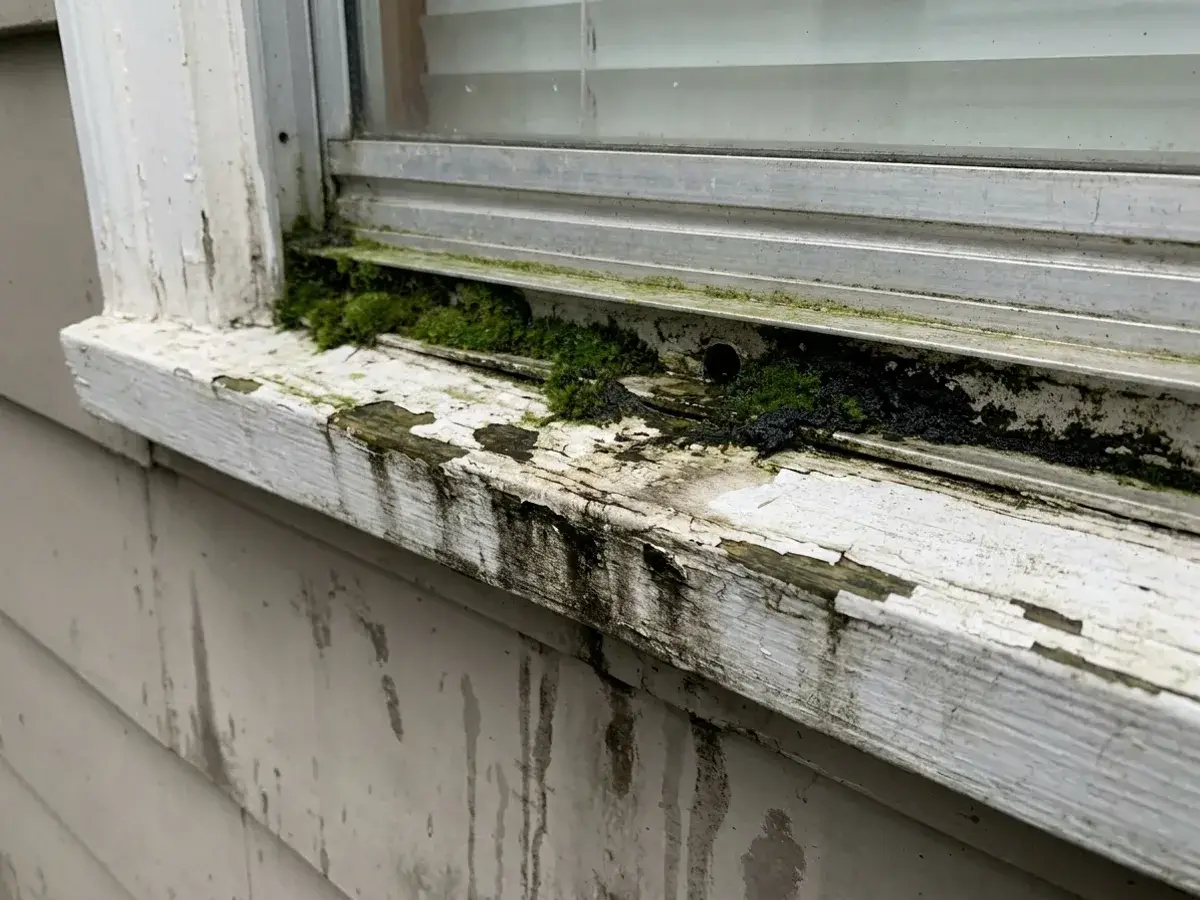
Everything running down the glass ends up here. On a sliding window the sash rides in a track that also serves as the drain channel, and the outer face of the frame has small slots, often behind a hinged flap, where the water is supposed to escape. In a shaded track the sequence is predictable. Dust and needles settle, moss takes hold in that layer, the slots close, and the channel starts storing water instead of passing it along. A frame that stops draining in the fall can then stay wet right through to spring.
We scoop the track out, open each slot from outside with a pick, then pour water into the channel and watch for it to come out. Seeing it run is the only real proof a slot is clear.
Below the sill: the drip groove and the siding
The water has two more places to cause trouble on its way down. A good sill has a groove cut along the underside of its nose so drops fall off rather than curl back toward the wall, and moss in that groove defeats it. Below that is the band of siding under each window, which takes the run-off from the frame and often shows a green or grey stripe. We clear the groove, wash the stripe off the siding with a low-pressure soft wash, and tell you if any trim feels spongy when pressed.
Patio doors are their own job
A sliding patio door is a window people walk through, and its track collects more than any other frame on the house: grit off shoes, pet hair, sand carried up from the beach, leaves blown across the deck. The track is long, low and sits beside deck boards that stay damp, so it fills faster than the windows above it. When a door starts to drag, the rollers usually get the blame. More often the track is packed. We empty the full length of it and the drain slots in the sill, and if the door still drags once the track is clean, that points to the rollers and we tell you so.
Dry summers hide it
Through a dry Oceanside summer, frame moss dries out, turns brown and shrinks, and a window can look as if it needs nothing at all. That dry plug in a weep slot swells straight back up with the first fall rain. Late summer, while the moss is brittle and the channels are empty, suits the work well, though spring is fine too. What matters is that the slots are open before the wet months arrive.
Where we see the most of it
On open waterfront lots facing the Strait of Georgia, frames on the water side tend to stay cleaner, since sun and wind dry them, while the landward wall is greener. On a treed acreage in Errington, the wall facing the woods keeps its windows damp long after every rain. Upstairs windows on two-storey houses are the usual reason people call us: clearing a track at the top of a ladder is awkward, and many homeowners in Qualicum Beach and Parksville would sooner not be up one at all.
How it works
How a window visit is organised
We work the shaded walls first, because their frames carry the most growth, then go round the rest of the house in one loop so ladders move as few times as possible.
Count and sort the windows
Before any tools come out we list every window and door, note which are upstairs, which slide, which are casements, and which tracks we can only reach with the sash opened from inside.
Screens out, growth out
Screens sitting in an outer track are lifted out and set aside. Moss, needles and packed grit come out of heads, beads and tracks with picks and soft brushes, followed by a low-pressure rinse.
Pour test every channel
Each bottom channel gets a slow pour of water while someone watches the slots outside. A slot that does not run is worked again until it does, or noted if something inside the frame is blocking it.
Screens back, notes handed over
Screens go back in, sills and decks below are swept, and you get a short list: which frames are sound, which trim felt soft, and any unit that has started to fog.
Done.
- You describe the roof.
- You approve a free quote.
- We clear the moss.
- The ladder stays in our truck, not your garage.
Want the green gone from your roof? Ask for a free quote and leave the climbing to our crew.
Booking window work
Window work is most often added to a roof visit. A wall that grows moss on its frames usually sits under a roof slope doing the same, so both get done while our gear is on site. Tell us roughly how many windows you have, which are upstairs and whether any doors drag, and ask for a free quote. For slowing regrowth on the roof above, see moss treatment and prevention.
Why choose us
Why choose us for window moss removal
Small tools for small gaps
Picks, narrow brushes and a hand sprayer. A window frame is fiddly, close-up work, and we treat it that way rather than hosing down the wall.
Clearing moss here since 2021
Five years around Oceanside, on roofs, paths and the frames under them, so we know which walls stay wet longest.
Ladder work that is covered
Upstairs frames mean a ladder against your siding. We carry insurance and are WCB-registered for exactly that.
Local crew, and a guarantee
Locally owned and operated. If a slot we opened is still holding water, tell us and we come back and make it right.
Got questions?
Questions about window frame work
Does someone need to be home to open the sliding windows?
Yes, but only briefly, and only for windows that slide. A sliding sash covers half of its own track, so to empty the whole channel we need it pushed open, which usually means someone opening it from indoors. Fixed panes and casement windows are done entirely from outside.
We sort out which ones need opening when we book, so you are not stuck waiting by a window all morning.
Can you fix a window that has already fogged between the panes?
No. Fog inside a double-glazed unit means its edge seal has failed, and that is fixed by replacing the sealed unit, which is glazier work. Clearing the frame afterwards still matters, because a new unit set into a channel that does not drain will meet the same fate.
We write down every fogged unit we see so you have a list ready when you call someone about glass.
Are there any windows you will not do?
A few. A window above a glass or plastic sunroom roof, one over a steep drop where a ladder cannot stand on firm footing, or one that can only be reached by leaning out from a roof edge, is not worth the risk to anyone.
If any of yours fall into that group, we tell you at the quote, not on the morning of the job.
What happens to my window screens?
On sliding windows the screen usually sits in the outer track, so it has to come out before the track can be cleaned. We lift each one out, brush off what is caught in the mesh, and set it back when the frame is done.
A screen that is already torn, bent or missing its pull tab is left as we found it and goes on your list.
Can I book only the windows, without the roof?
Yes. Many houses have clean roofs and mossy frames, especially where a deep overhang keeps rain off the shingles but also keeps sun off the walls. Windows-only visits are quoted on their own, by how many frames there are and how many are upstairs.
What can I do between visits?
On windows you can reach from the ground, run a vacuum crevice tool along the track once in late summer while everything is dry, and keep shrubs trimmed so they do not touch the wall. Both help the frame dry out after rain.
Leave the upper windows to us rather than balancing on a stepladder with a hose.
Window Moss Removal in Parksville and Oceanside
Tell us the address and we will get you a price.