
Whole-roof soft wash
Roof Cleaning: Stripes, Film and Lichen Washed Off Gently
A roof can be striped, filmed and crusted all at once. We sort out which marks are growth, wash those off at low pressure, and tell you about the ones a wash cannot fix.
Customer reviews
What customers say
Amazing! Sent in a request form on their website in the morning, heard back that afternoon, and booked for the next day. Very fast, reliable, and efficient.
They are efficient, hardworking, and reliable. I’ll definitely call them again for other services. Highly recommended!
Great customer service, and they came quickly..will be using again for sure
Why us
Why customers love our service
And why you will get the best moss removal service in Parksville!
Fast and efficient moss removal
We arrive on the agreed day, finish every slope we quoted for, and leave the yard as tidy as we found it.
Clear and quick communication
Calls and texts get answered, the price is settled before work begins, and afterwards we tell you how the roof looked.
Five-star reviews
Homeowners rate our crew five stars, review after review.
Clearing moss since 2021
Five years on Oceanside roofs of every kind: asphalt, cedar, tile and metal, plus the paving beneath them.
- A walk around the house first, marking which stains are growth and which are wear
- Loose needles, cones, bark and leaves swept off by hand before the wash
- Garden beds and shrubs below the eaves soaked beforehand and rinsed afterwards
- Algae stripes and green film washed off every slope at low pressure
- Lichen rosettes treated so they dry out and drop over the following months
- Moss and debris that wash into the trough lifted out and bagged
- A plain note of anything we saw that wants a roofer's attention
Before and after
One roof, before and after
Before and after, joined in a single image.
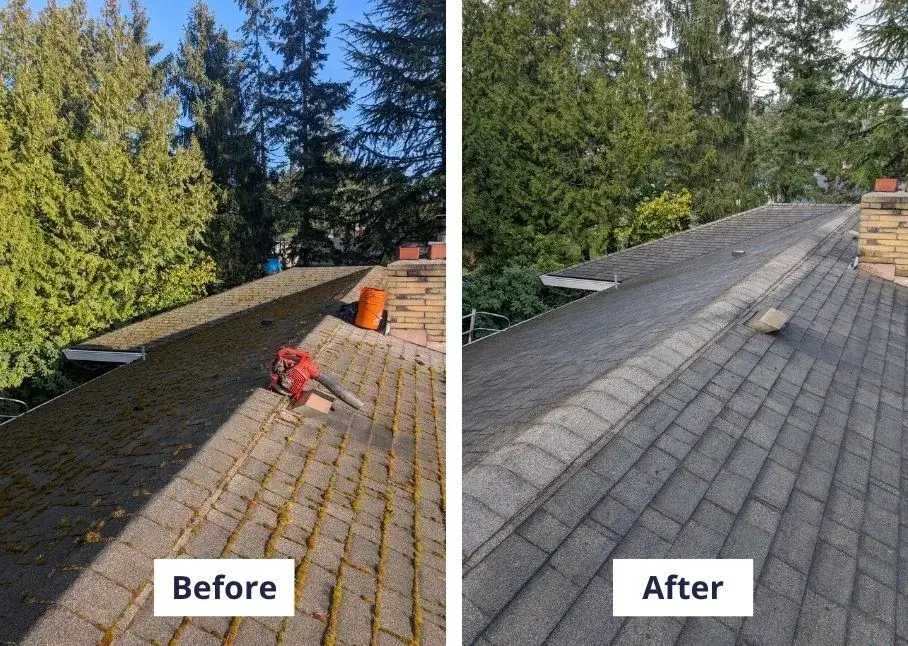
Most people who call about a roof that “looks dirty” are really describing colour. One roof can carry black stripes, a dull green film, grey and yellow crusts and a rust-red run all at the same time, and only some of those marks are alive. Before anything gets washed, we work out which is which, because a wash only helps with the living ones. This page covers cleaning the whole roof surface. Thick, spongy moss has its own page under roof moss removal, and the hands-on demoss visit is set out on roof demossing.
Read your roof by its colours
On a dry afternoon, stand at the end of the driveway and look at the slope that gets the least sun. These are the marks we see most often.
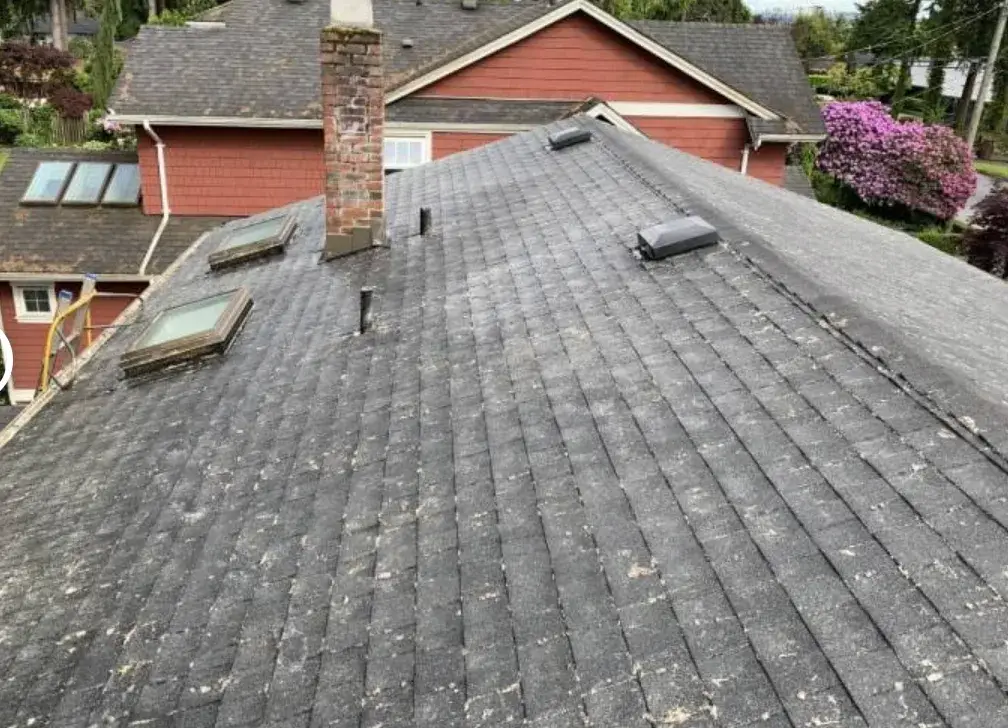
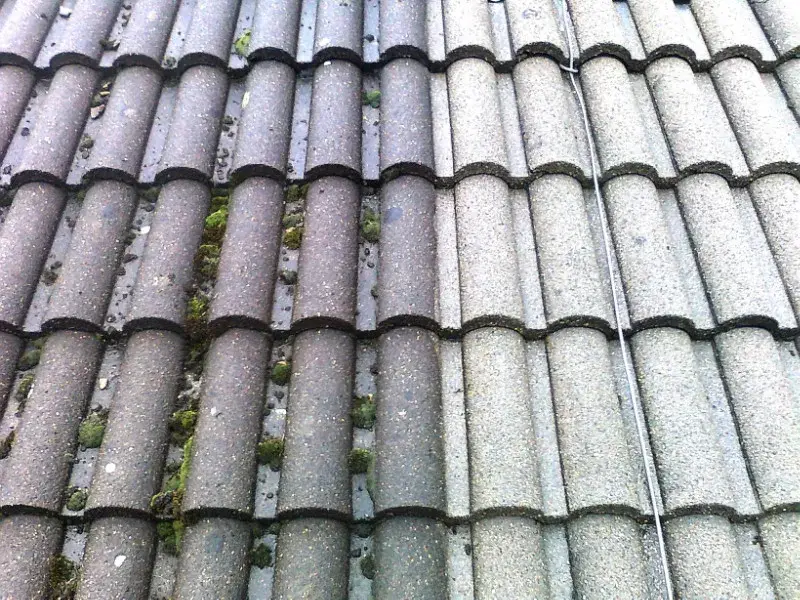
Long black or dark brown stripes. Algae. The stripes follow the path the rain takes off the roof, so they run straight down the slope in bands, darkest where the runoff is heaviest. Many asphalt shingles carry a limestone filler that the algae feeds on. This one washes off.
A dull green film. A thin coat of algae and the first stage of moss, often on the lowest few courses or on the shady side of a dormer. It comes before the cushions, and it is the easiest point at which to deal with growth.
Flat rosettes, grey-green, mustard yellow or orange. Lichen. It locks onto the granules and will not rinse off. We treat each patch and let the weather finish it.
Dark patches that look bald. Often not growth at all. Where granules have worn away, the darker mat underneath shows through. No wash will brighten that, and washing hard would make it worse, so we note where these patches are and leave them alone.
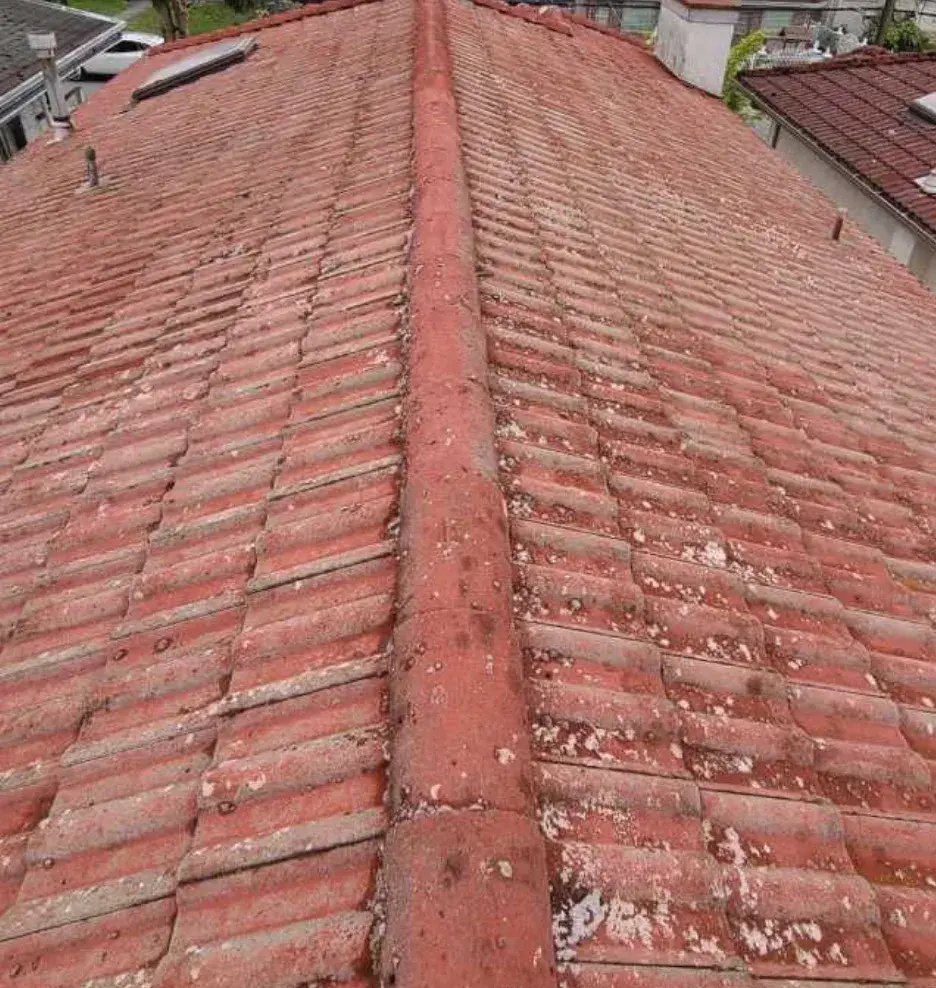
Rust-coloured runs. Nearly always staining from a steel fitting further up, such as a vent cap, a dish mount or exposed nail heads. The surface stain can be lightened, but it will come back while the source is still up there.
How the wash is done
First the roof is cleared of anything loose. Needles, cones, bark and leaves get swept off by hand, because a cleaning solution cannot reach a shingle that is buried under a wet layer of litter. The beds and shrubs under the eaves are soaked so they take up water rather than runoff.
Then the solution goes on at low pressure, slope by slope, and is given time to work on the algae and film. The rinse that follows is gentle and only carries the loosened growth away. Higher pressure does have a place in our work, on ground-level concrete such as the jobs on our driveway and sidewalk page. It never goes on asphalt shingles or cedar shakes. Details change from one roofing material to the next, so cedar shake, asphalt shingle and tile and metal roofs each have a page of their own.
How it works
How Booking Your Roof Works
Four steps, and only the first one needs anything from you. Describe the roof, approve the price, and stay on solid ground while we work.
Describe the roof
Two minutes on the phone or the form.
The address, how many storeys, the roofing material if you know it, and roughly how green it looks from the yard. Mention any big trees nearby.
Approve the price
Every quote is worked out for one roof.
Steepness, height, material, the depth of the moss and how we reach each slope set the figure. It is free, and you have it in hand before any work begins.
The moss comes off
Our crew handles the climbing.
Scrapers and brushes take the moss off the courses, a treatment goes on if it will help, and the bagged moss leaves in our truck. If washing is needed, it is a low-pressure soft wash; asphalt shingles and cedar shakes never see high pressure.
Hear what we saw
Nothing up there stays a mystery.
A curled tab, a split shake, bare patches where granules have gone, or flashing pulling loose: we tell you where it is, and the next step is up to you.
Done.
- You describe the roof.
- You approve a free quote.
- We clear the moss.
- The ladder stays in our truck, not your garage.
Want the green gone from your roof? Ask for a free quote and leave the climbing to our crew.
Timing it around the Oceanside year
Most of the rain here falls between October and April. In Qualicum Beach that stretch brings roughly four-fifths of the year’s precipitation. Algae and moss green up and spread through the wet months, then dry and brown through the summer.
A soft wash wants a few dry hours after it goes on, so the long dry run from late spring into early fall is the easiest window, with dry spells in the shoulder months as a second choice. There is also a case for washing in late summer: the lichen has been treated, and the first steady fall rain does the slow job of rinsing the dead crust away.
What lands on roofs here, and when
Much of the low land around Parksville sits in the Coastal Douglas-fir zone, the smallest of BC’s ecological zones, and its trees keep a roof supplied with litter. Fir needles and cones, dead cedar fronds, and in autumn the big maple leaves and their winged seeds all end up lodged on shingles, and an arbutus adds its bark and leaves in midsummer.
Big trees are not only a rural feature. Qualicum Beach keeps a stand of old-growth Douglas fir, the Heritage Forest, inside the town. Inland around Coombs, a house roof often comes with a shop or barn roof that sits in shade most of the day. Waterfront homes facing the Strait of Georgia tend to dry faster in the wind and sun, though their shaded sides still pick up stripes.
The work
On the job
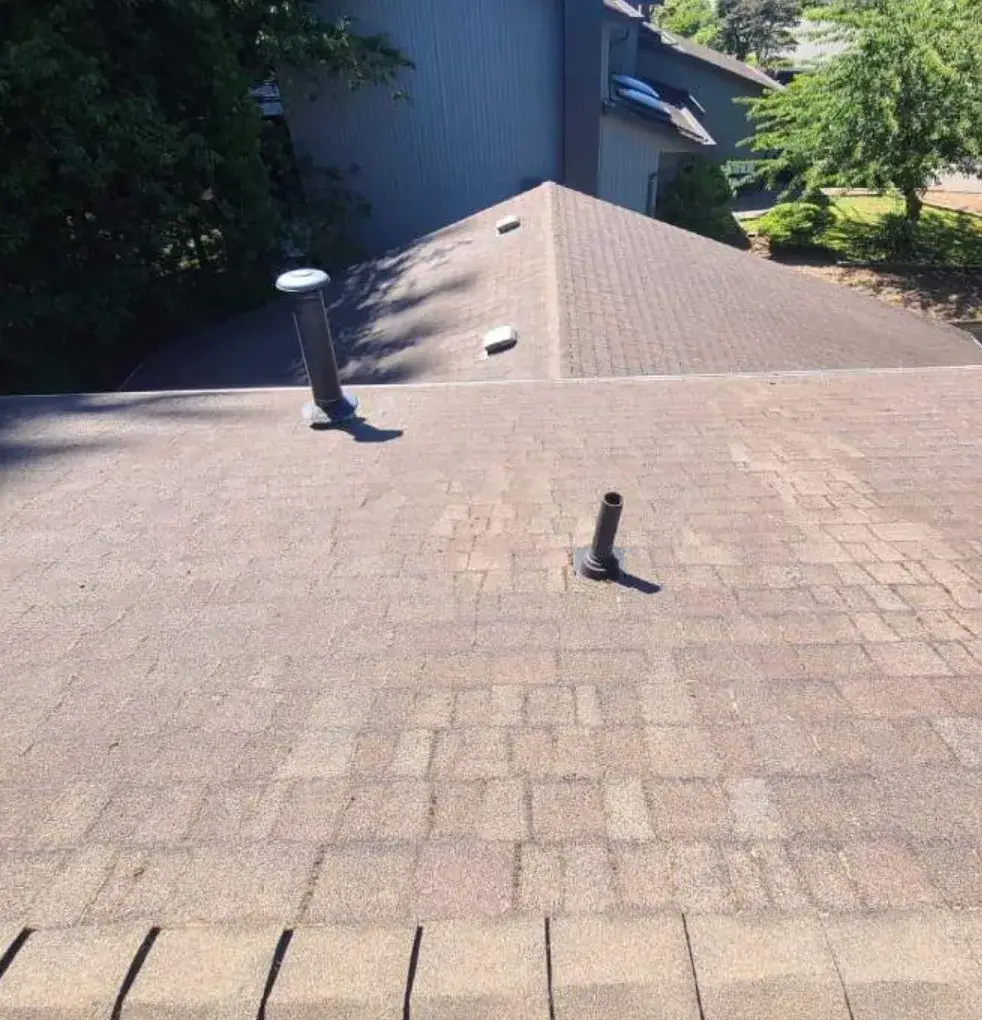
Where a clean stops
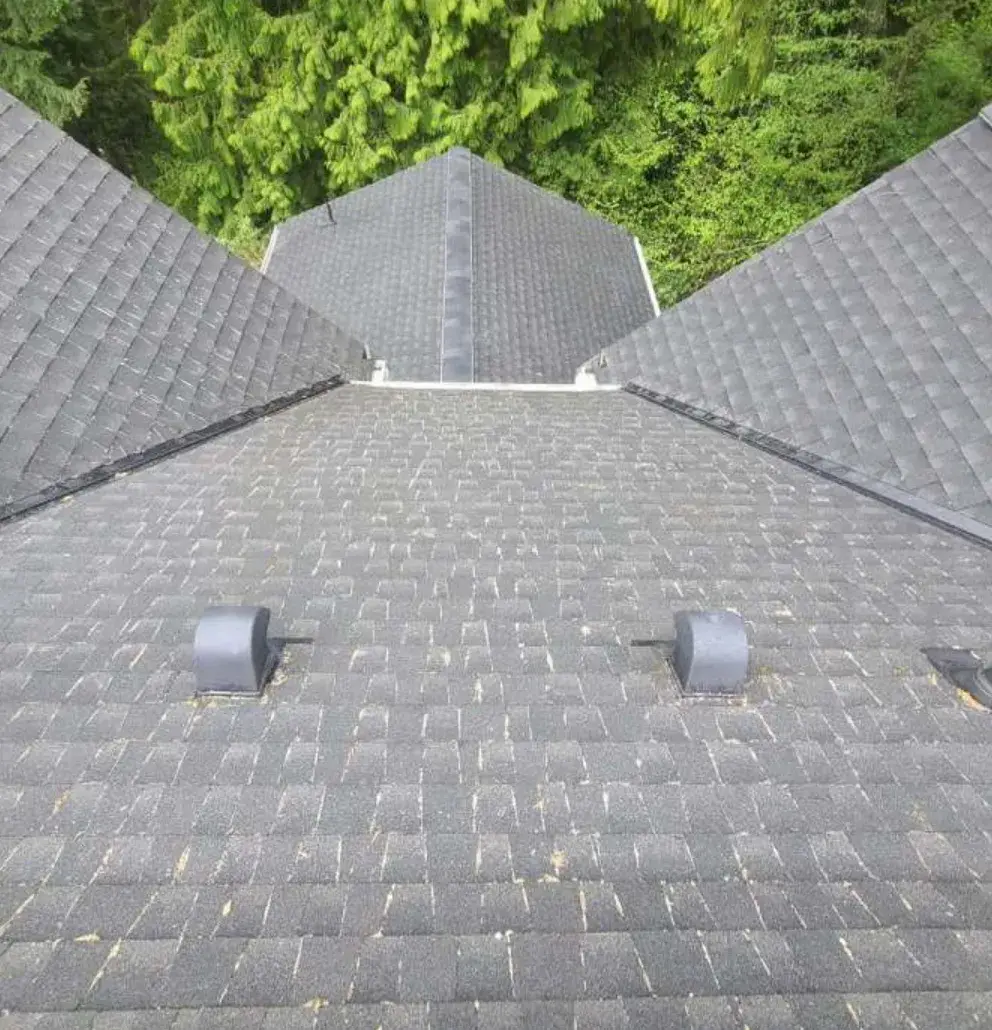
A wash is not a repair. If we see a cracked vent boot, a loose ridge cap, a lifted flashing or a run of curled shingles, we point it out and leave the fixing to a roofer. The bald patches and rust runs described above stay on your list too, not ours.
A clean roof also starts growing again. How quickly depends on shade more than anything, and our moss treatment and prevention page explains what can slow it.
We have been clearing moss since 2021, we are insured and WCB-registered, and every wash comes with our guarantee. We work across Parksville, Qualicum Beach, Nanoose Bay and the rest of Oceanside. Send us a note through the contact page describing the colours you can see from the ground, and we will come and give you a free quote.
Why choose us
Why choose us for roof cleaning
Low pressure on the roof itself
Shingles and shakes are washed at about garden-hose force. The solution does the cleaning, so the surface layer of the roof is left where it belongs.
Clearing moss since 2021
Five years on Oceanside roofs, from waterfront lots on the Strait to acreages under tall fir inland.
Insured and WCB-registered
Washing a roof means ladders and slopes. Our insurance and WCB registration are in place before the first ladder goes up.
A guarantee, locally owned
Locally owned and operated. If a slope we washed does not come up right, we come back and make it right.
Got questions?
Questions about having a roof washed
Can you wash just the one slope that looks bad?
Yes. We quote slope by slope, so a single north face or the side under the neighbour's fir can be done on its own.
We will still look over the rest while we are up there. A faint green tinge on the next slope is easier to deal with now than in two winters, but whether to add it is your call.
How do you look after the garden, pond and lawn under the eaves?
Beds and shrubs along the drip line get a thorough soaking before any solution goes on, and a second rinse once we finish. Ponds, rain barrels and anything a downspout empties into are covered or the outlet is turned away for the day.
We tell you which product we used and how it was applied, so you are not guessing about what went on your roof.
Will a rain shower the next day undo the wash?
Not once the solution has had its time on the roof and been rinsed. Light rain after that helps, because it carries on loosening what is left.
A downpour straight after the solution goes on is a different matter, as it thins it before it can work. That is why we book washes for a dry spell and would rather move the date than wash into a storm.
How soon will the roof look different?
The black stripes and green film are noticeably lighter on the day. They keep fading over the next few weeks of weather.
Lichen is slow. Expect the crusts to bleach, curl at the edges and fall away over a few months rather than leave with us.
Is roof cleaning the same thing as roof demossing?
They overlap, but the jobs are weighted differently. Demossing is mostly hand work: lifting thick cushions out of courses and valleys. Cleaning is mostly the wash: stripes, film and crusts over the whole surface.
Many roofs need some of both. Our roof demossing page explains how that visit runs.
Does a clean roof mean my shingles are in good shape?
Not necessarily. A wash shows the surface as it really is, which sometimes means bare patches and curled edges are easier to see afterwards.
We tell you what we noticed, but we do not put a number of years on a roof. A roofer or a home inspector is the right person for that.
How often will the roof need washing?
It comes down to sun and trees. An open slope that dries quickly after rain can go several years. A shaded slope under fir or cedar may show stripes again within two or three.
The growth does return on this part of the coast. Our moss treatment and prevention page covers ways to slow it between washes.
Roof Cleaning in Parksville and Oceanside
Tell us the address and we will get you a price.