
A year on the roof
Moss Prevention on Oceanside Roofs, Season by Season
Moss on this coast keeps a calendar. We plan treatment, zinc strips, branch advice and short checks around it, and show you what to watch for from the lawn.
Customer reviews
What customers say
Great customer service, and they came quickly..will be using again for sure
They do a great job and provide great customer service! They are always reliable. Thank you,
Great experience working with this company! Quick turn around time and very professional. I’ll definitely be using their services again in the future.
Why us
Why customers love our service
And why you will get the best moss removal service in Parksville!
Fast and efficient moss removal
We arrive on the agreed day, finish every slope we quoted for, and leave the yard as tidy as we found it.
Clear and quick communication
Calls and texts get answered, the price is settled before work begins, and afterwards we tell you how the roof looked.
Five-star reviews
Homeowners rate our crew five stars, review after review.
Clearing moss since 2021
Five years on Oceanside roofs of every kind: asphalt, cedar, tile and metal, plus the paving beneath them.
- A walk around the house to see which slopes stay shaded, and why
- Treatment put on a cleared roof during a dry spell, not in the rain
- Plantings under the eaves covered or soaked with water before we start
- Fallen needles and leaves swept out of valleys and off the lower courses
- Moss that has washed into the gutter trough lifted out and bagged
- An honest guess at when the roof will next want a look
Before and after
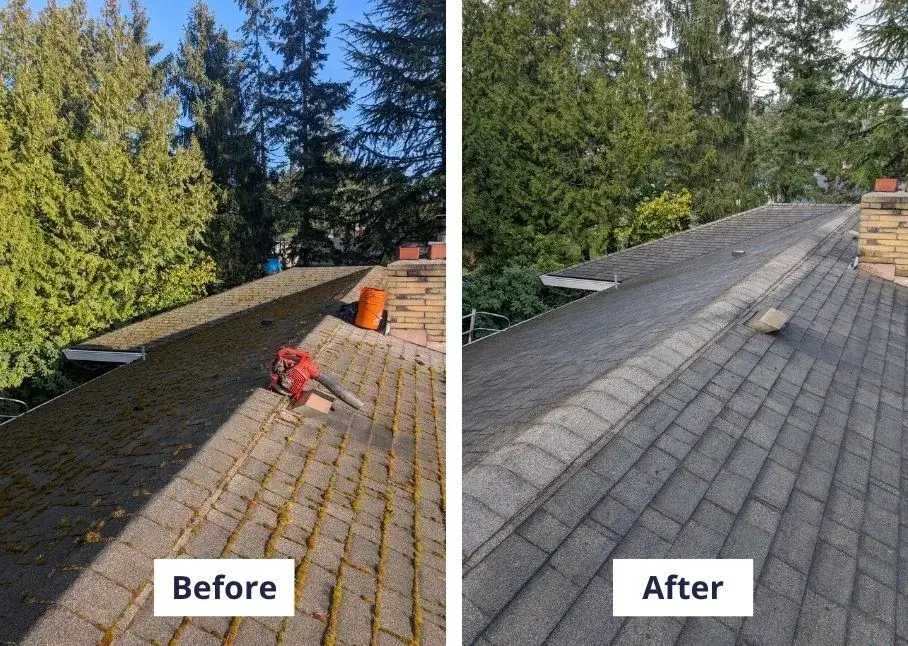
One roof, before and after
Before and after, joined in a single image.
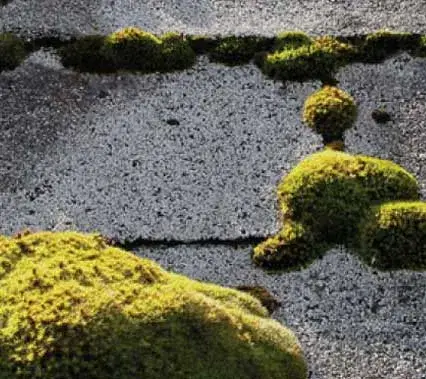
On this coast, moss runs to a calendar. It does almost all its growing in the wet months, sits brown and still through the dry summer, and swells up green again once the fall rain settles in. Keeping it down on a cleared roof is mostly a matter of doing the right small job at the right point in that year, some of it by us and some of it by you from the lawn. This page goes through the year in order. If your roof is still carrying a thick mat, the first step is roof moss removal. Treatment and prevention come after the clear, never in place of it.
October and November: leaves down, rain back
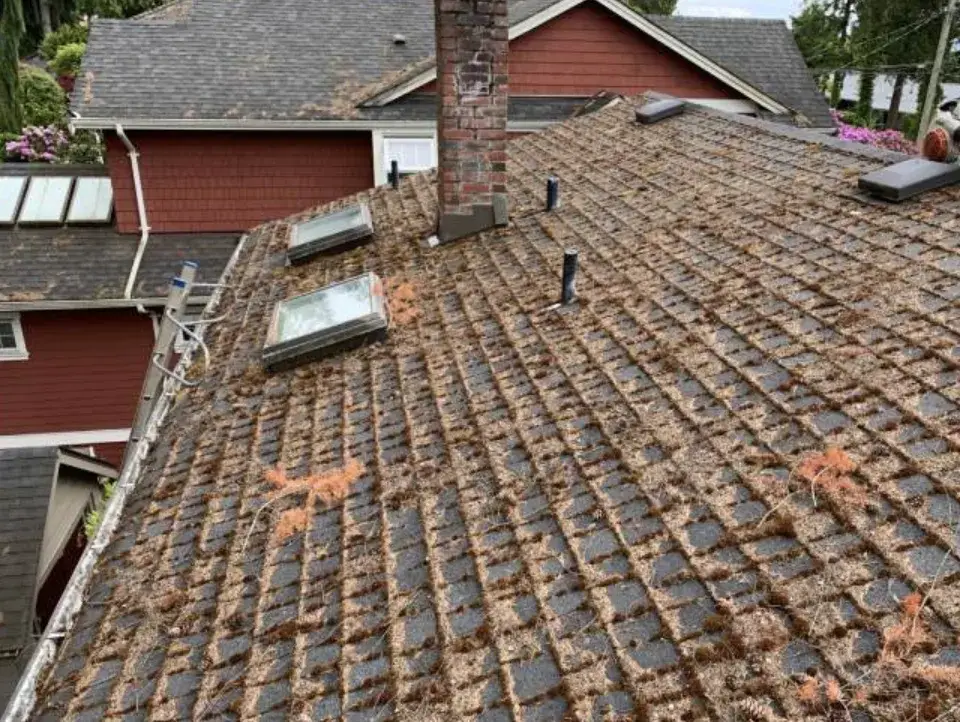
The first steady rains wake up anything left on the roof, and the trees choose the same weeks to unload. Bigleaf maples drop their broad leaves and winged seeds. Douglas fir and western red cedar keep shedding needles and dead fronds. All of it slides down until something stops it: a valley, the uphill side of a chimney, the back of a skylight, the bottom row of shingles above the gutter. Those damp little piles are where new moss gets its start.
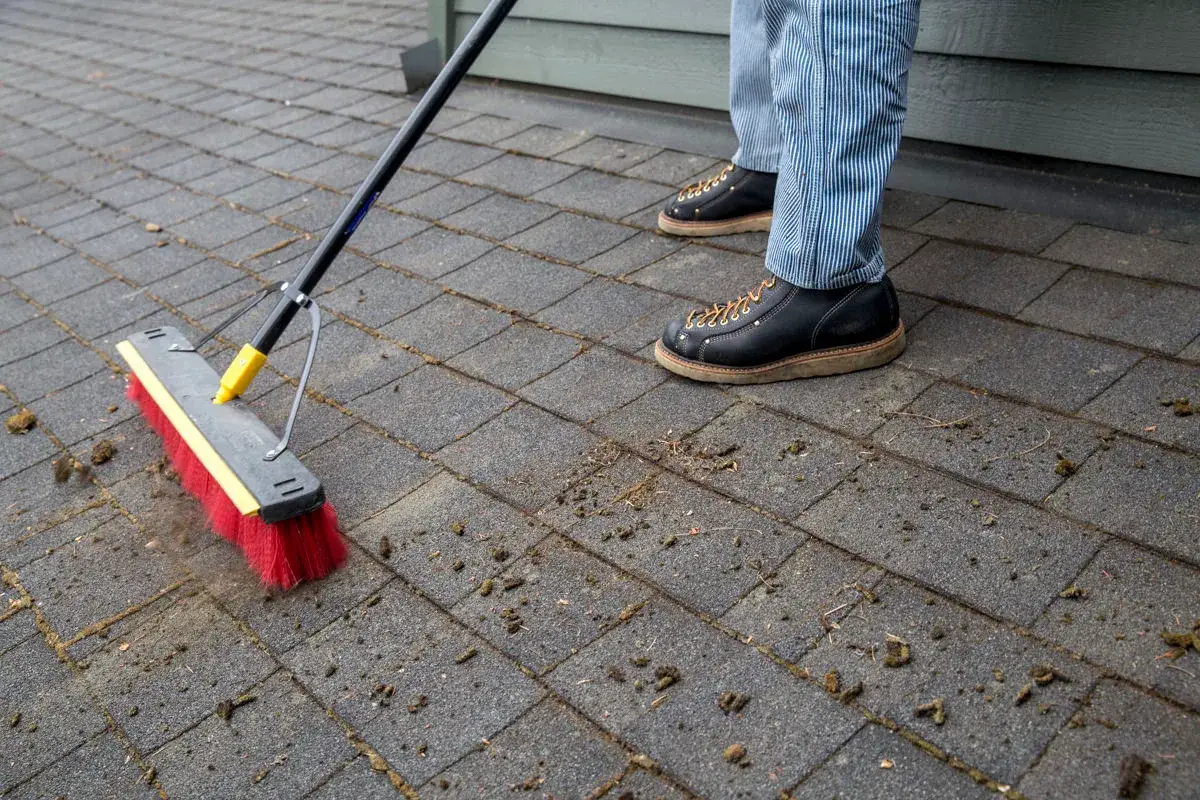
That is why our most useful fall job is a sweep, not a spray. Once the leaves are down, we clear the loose litter from valleys and roof edges and lift out any moss that has washed down into the gutter trough. Treatment in these months is mostly wasted. A roof that is wet for days at a time rinses it off before it can work, and we will not sell you something that will end up in the downspout.
December to February: watch it from the ground
Midwinter is the season for looking, not climbing. A shaded slope in January may not dry out for weeks, and wet shingles carrying a film of algae are slippery even in soft-soled shoes. Whatever your age or your ladder, a winter roof is not worth the risk.
What you can do is stand back on the lawn, or across the street, and look at the north-facing slope and the bottom edge of the roof. A faint green tinge along the bottoms of the shingle tabs is the first sign of growth. At that stage it is a film, and a film is cheap to deal with. Take a photo from the same spot each winter and you will have a record of how fast your roof greens up, which is the most useful thing you can send us.
March and April: the branch conversation
As the rain eases, we can get onto roofs again for clearing and checks, and that is the best time to talk about trees. Standing on the ridge, we can see which limb keeps which slope in shade, and where a cedar hedge has grown up past the gutter line. Tree cutting is not something we offer. We point out the specific branches, and you can take that list to an arborist.
Removing a single limb, or two, often does more for a roof than anything we put on it, because a slope that dries quickly after each shower is a hard place for moss. On a shaded acreage in Hilliers, where a workshop or barn may sit under trees all day, this is usually the biggest single change on the property.
Late spring to early fall: the treatment window
We book treatment for a dry stretch between late spring and early fall, because it only works on a cleared roof that is dry when we apply it and stays dry for several days afterwards. It is a liquid that finishes off spores and the faint film a brush leaves behind. Nothing visible happens on the day. Over the following weeks and months, the dead film browns, loosens and weathers away.
Before any treatment, we tarp or water down the garden beds and shrubs below the eaves, since whatever lands on a roof eventually comes off it through the downspouts. We apply in a controlled line along the courses and keep it to the roof, and we tell you which product we used.
The dry months are also when we fit zinc strips. A strip along the ridge releases a trace of zinc every time it rains, which makes the shingles just below it harder for new moss to settle on. The effect is strongest near the top and fades on the way down. On a plain gable roof with short slopes, that covers a fair share of the surface. Where the slopes run long, or dormers break them up, it only protects the upper part, and we tell you that before we fit one.
July and August also bring the most common misunderstanding we hear. Moss that has dried out looks brown and dead, and many people assume the problem has solved itself. It has not. It is waiting for the rain.
How it works
How Booking Your Roof Works
Four steps, and only the first one needs anything from you. Describe the roof, approve the price, and stay on solid ground while we work.
Describe the roof
Two minutes on the phone or the form.
The address, how many storeys, the roofing material if you know it, and roughly how green it looks from the yard. Mention any big trees nearby.
Approve the price
Every quote is worked out for one roof.
Steepness, height, material, the depth of the moss and how we reach each slope set the figure. It is free, and you have it in hand before any work begins.
The moss comes off
Our crew handles the climbing.
Scrapers and brushes take the moss off the courses, a treatment goes on if it will help, and the bagged moss leaves in our truck. If washing is needed, it is a low-pressure soft wash; asphalt shingles and cedar shakes never see high pressure.
Hear what we saw
Nothing up there stays a mystery.
A curled tab, a split shake, bare patches where granules have gone, or flashing pulling loose: we tell you where it is, and the next step is up to you.
Done.
- You describe the roof.
- You approve a free quote.
- We clear the moss.
- The ladder stays in our truck, not your garage.
Want the green gone from your roof? Ask for a free quote and leave the climbing to our crew.
September: a short look before the rains
If your roof is due for another look, early fall is the time, while it is still dry enough to work on safely. A check is short. We brush away any new green, clear the valleys, make sure any zinc strip is still fastened tight, look at the moss line along the bottom courses, and, if the dry weather is holding and you want one, put a treatment on before the rain returns. Any washing on a check is a low-pressure soft wash, and we never point high pressure at an asphalt shingle or a cedar shake. Whole-roof washing of algae streaks is its own job, covered on roof cleaning.
How often a roof needs this varies a great deal. An open, sunny roof can go several years between checks. A north slope under tall fir may want one every second year. We give you our estimate after each visit and leave the timing with you.
The work
On the job
Talk to us about your roof’s year
Parksville Moss Removal has worked on roofs around Oceanside since 2021. Our crew is insured and WCB-registered, a quote costs nothing, and when a visit does not do what we said it would, we come back and make it right. Send us a note with a photo or two of the shaded side and a word on when it was last cleared, and we will suggest which of these jobs, if any, belongs on your roof this year. A demoss visit from start to finish is described on roof demossing.
Why choose us
Why choose us for moss treatment & prevention
Planned around the weather
We book treatment for the dry months and checks for early fall, because that is when the work does the most for your roof.
Five years on these roofs
We have cleared and treated roofs around Parksville since 2021, under fir, cedar and maple, on open waterfront lots and shaded acreages alike.
Insured and WCB-registered
Every return visit puts us back on your roof, and our insurance and WCB registration cover each one.
We make it right
Parksville Moss Removal is locally owned. If a treatment or check of ours falls short of what we told you, we come back and make it right.
Got questions?
Questions about keeping moss down
My roof turned brown over the summer. Has the moss died?
Usually not. Moss dries out and goes dormant when the rain stops, and a dormant cushion looks brown, flat and finished. Give it a week or two of steady fall rain and it swells up green again.
A brown roof in August is a good time to have it cleared, though, because a dry cushion is lighter to lift off than a soaked one.
What can I do myself between visits, without getting on the roof?
Watch the north slope and the bottom edge of the roof from the lawn, especially in late winter. Take a photo from the same spot each year so you can compare. Keep an eye on how far the trees have grown out over the roofline.
That is plenty. Climbing a damp roof to scrape a patch is how people get hurt, and it is not worth it for a bit of green.
You are clearing my roof in November. Can you treat it on the same visit?
We would rather not charge you for that. Treatment put onto a roof that will be wet for most of the next few months mostly rinses off before it has done anything.
We clear the roof when it needs clearing, then suggest a short return visit in a dry stretch between late spring and early fall for the treatment.
Can a zinc strip go on a cedar shake roof?
Sometimes. The strip has to be fastened through shakes along the ridge, and older shakes that are dry, thin or cracked can split. We look at the ridge shakes first.
If they are sound, a strip can help the top part of each slope. If they are not, we say so and leave it off.
Does a waterfront house facing the Strait need less of this?
Often a little less. Open slopes in sun and wind dry quickly after rain, and moss finds that hard going.
But the side of the house away from the water, a slope under one big fir, or a corner where two roof planes meet can still green up as fast as any roof inland. We look at each slope, not the address.
What do you need from me to plan prevention for my roof?
Tell us when the roof was last cleared, what it is covered with if you know, and which trees stand near it. A couple of photos of the shaded side, taken from the ground, help a lot.
From that we can tell you whether treatment, a zinc strip, a check or simply leaving it alone makes sense.
Will treatment mark my siding, deck or windows?
We keep the treatment on the roof and work in a controlled line rather than spraying across the whole slope. Anything that drifts onto glass or painted trim gets rinsed off with plain water while we are there.
We also tell you the product's name so you can read the label yourself.
Do I have to sign up for a schedule?
No. There is no plan to join and nothing to renew. After each visit we tell you roughly when we think the roof will need us again.
If you would like a reminder at that point, ask, and we will get in touch then. Otherwise the call is yours.
Moss Treatment & Prevention in Parksville and Oceanside
Tell us the address and we will get you a price.