
Ridge to drip edge
Roof Demossing in Parksville, One Part of the Roof at a Time
A roof is not one surface. Ridges, valleys, vents and the lowest courses each need different handling, and this page goes through them in the order we work them.
Customer reviews
What customers say
Great job and fair pricing! Will hire again!
The service provided by the owners of the company and the staff were beyond exceptional. The price was also very exceptable and affordable.
Amazing! Sent in a request form on their website in the morning, heard back that afternoon, and booked for the next day. Very fast, reliable, and efficient.
Why us
Why customers love our service
And why you will get the best moss removal service in Parksville!
Fast and efficient moss removal
We arrive on the agreed day, finish every slope we quoted for, and leave the yard as tidy as we found it.
Clear and quick communication
Calls and texts get answered, the price is settled before work begins, and afterwards we tell you how the roof looked.
Five-star reviews
Homeowners rate our crew five stars, review after review.
Clearing moss since 2021
Five years on Oceanside roofs of every kind: asphalt, cedar, tile and metal, plus the paving beneath them.
- Ridge caps and hips cleared from one end to the other
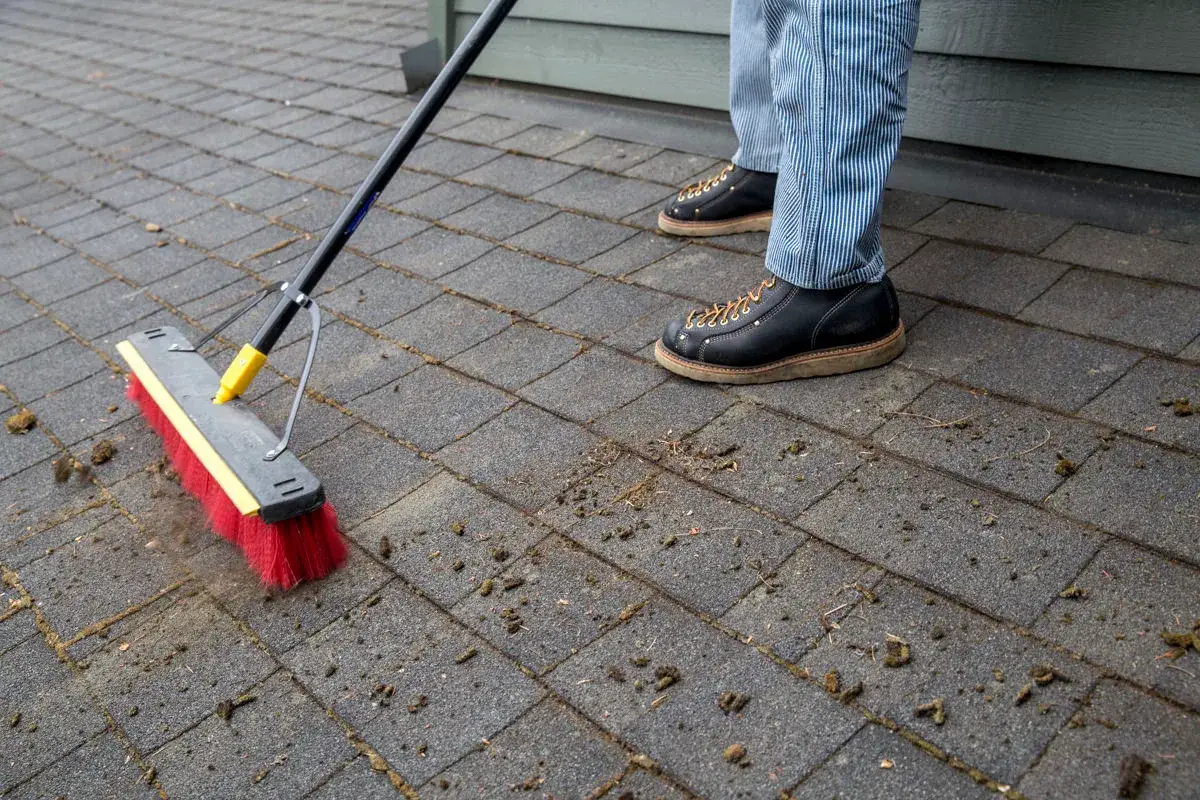
- Every slope worked from the top down with plastic scrapers and soft brushes
- Valleys emptied by hand down to the gutter
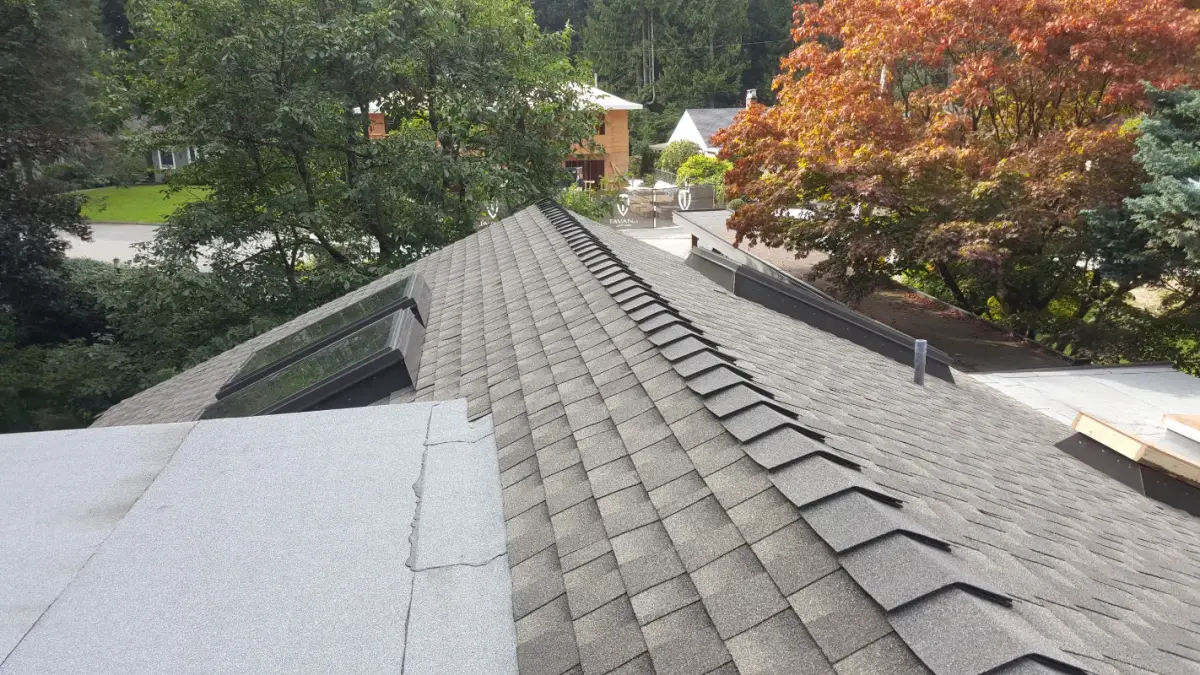
- Careful work around chimneys, skylights, vent pipes and solar panels, with no weight put on any of them
- Washing, where needed, done as a low-pressure soft wash; high pressure is never used on asphalt shingles or cedar shakes
- Remaining root traces treated, if you choose a treatment, so they wither instead of being scraped out
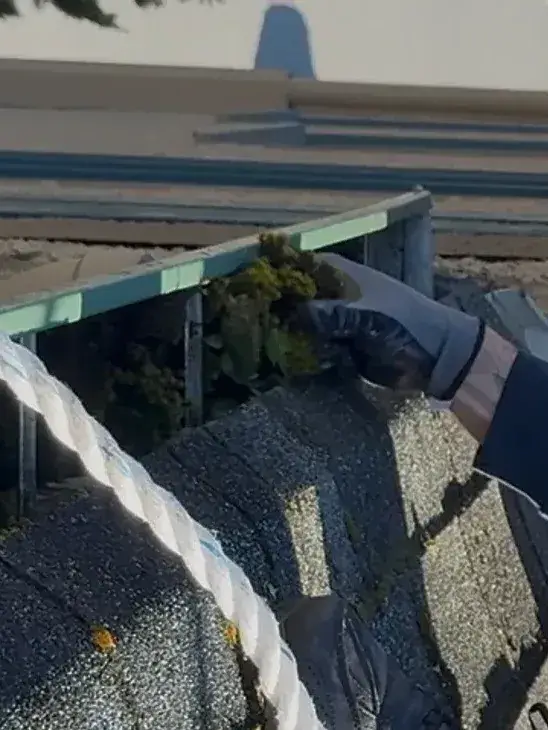
- Moss lifted out of the gutter trough, bagged with the rest and taken off the property
- A slope-by-slope account of what we found, flashing and fittings included
Before and after
One roof, before and after
Both photos in a set come from the same position, taken as we arrive and again once the moss and debris have been cleared away.
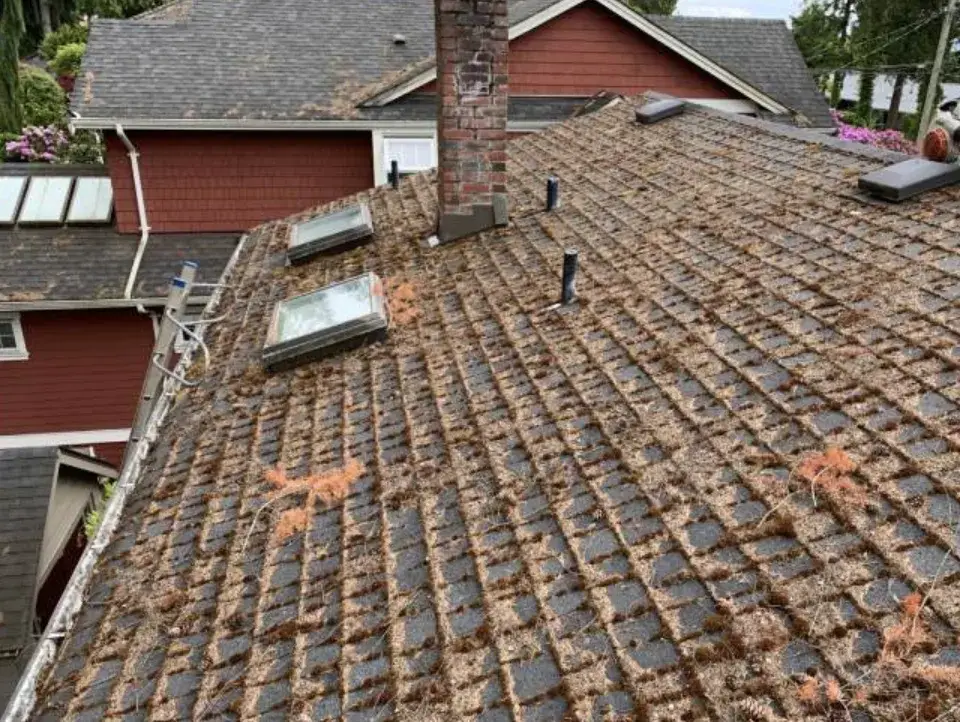
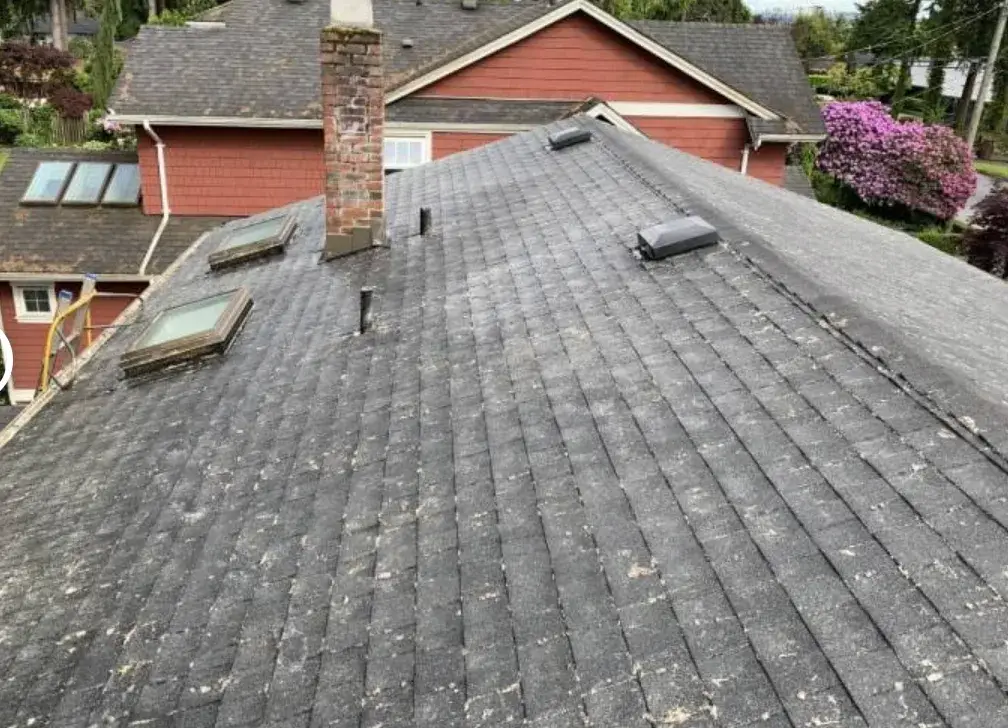
Ask someone to picture a mossy roof and they see one green slope. A roof is really several jobs joined together. The ridge, the open slope, a valley, the ring around a skylight and the bottom row of shingles each hold moss differently, and each needs its own handling. This page goes through the parts of a roof in the order we demoss them, and says what we do at each one. If you are still deciding whether your roof needs the work at all, roof moss removal covers how growth builds up and why we take it off by hand.
Ridge caps and hips
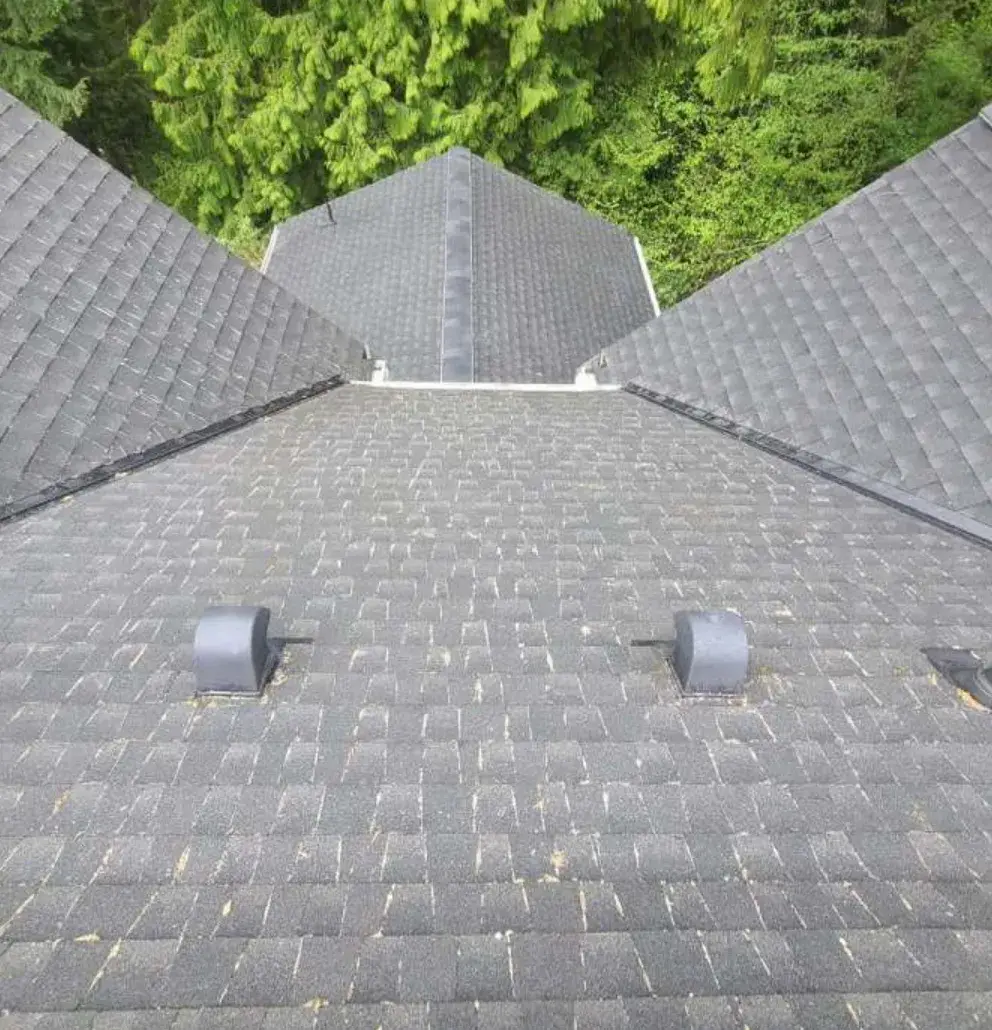
We start at the top line. Ridge caps are folded or cut shingles laid over the peak, and moss likes the lip where each cap overlaps the next. Hips, the sloping lines where two faces meet on the outside corner, collect it the same way. From the lawn this growth looks like a thin green seam, so it is easy to underestimate.
We clear the caps from one end of the ridge to the other, lifting the moss away from the lip instead of prying under it. A cap that has cracked or lost its seal shows up at this point, and we make a note of it for you.
The open field of each slope
The broad middle of each face is where most of the moss usually is, and where most of the time goes. We scrape the thick cushions off with plastic tools and follow with a soft brush, working down the slope in passes about a ladder’s width wide.
Which slope takes longest depends on the lot. A face that looks out over the water toward the Strait of Georgia and gets sun and wind may carry only scattered tufts. The north side of the same house, or any face under Douglas fir and western red cedar, can be carpeted. Inland around Errington and Coombs, where taller trees close over the roof, we often spend more time on one shaded face than on the rest of the house together.
Valleys
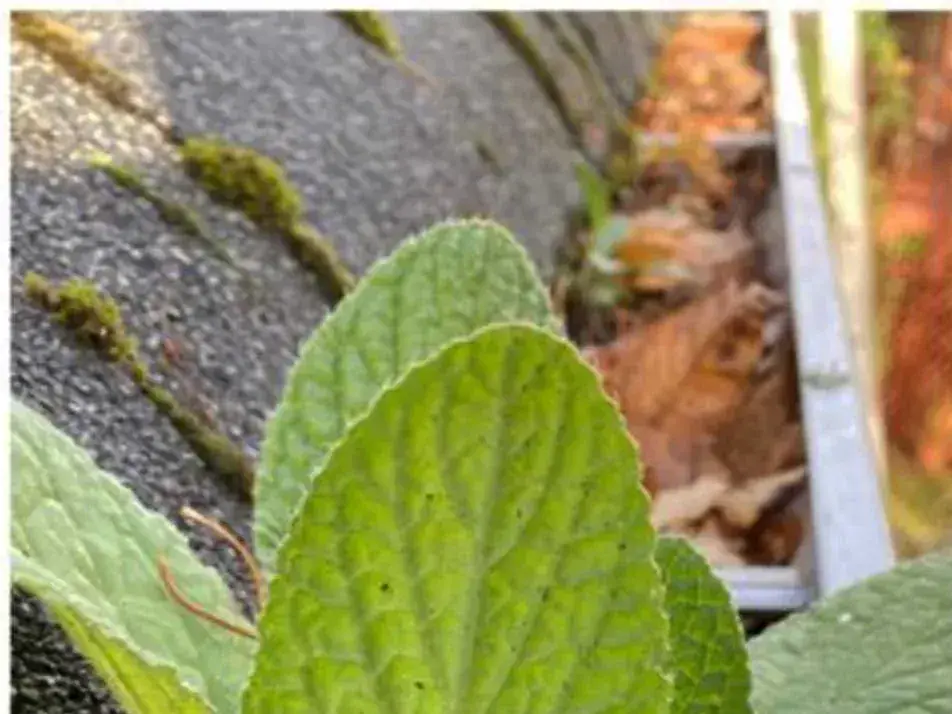
A valley is the channel where two slopes meet on the inside corner, and it carries the water from both. It also catches everything that rolls down them: fir needles, cedar fronds, bigleaf maple leaves and keys in the fall, and arbutus bark and leaves in midsummer. That debris packs down, stays damp and grows moss from the inside.
We empty valleys by hand along their whole length, right down to where they run into the gutter. Whether the valley is lined with metal or woven shingle, nothing sharp touches it.
How it works
The order a roof gets worked in
The sequence follows gravity. Whatever we loosen high up has to travel down over the roof, so the high parts come first and the edges come last.
Look from the lawn
Before climbing, we walk all four sides with you and pick out the heavy slopes, the valleys, the trees overhead and anything fitted to the roof.
Top line first
Ridge caps and hips are cleared from end to end, so nothing loosened up there lands on courses we have already finished.
Slopes, valleys, fittings
Each face is brushed and scraped downhill, then the valleys and the moss packed around chimneys, skylights and vents are lifted by hand.
Edges, bags and a report
Starter courses and the trough come last, the moss is bagged and driven away, and we tell you what each part of the roof looked like.
Chimneys, skylights, vents and solar
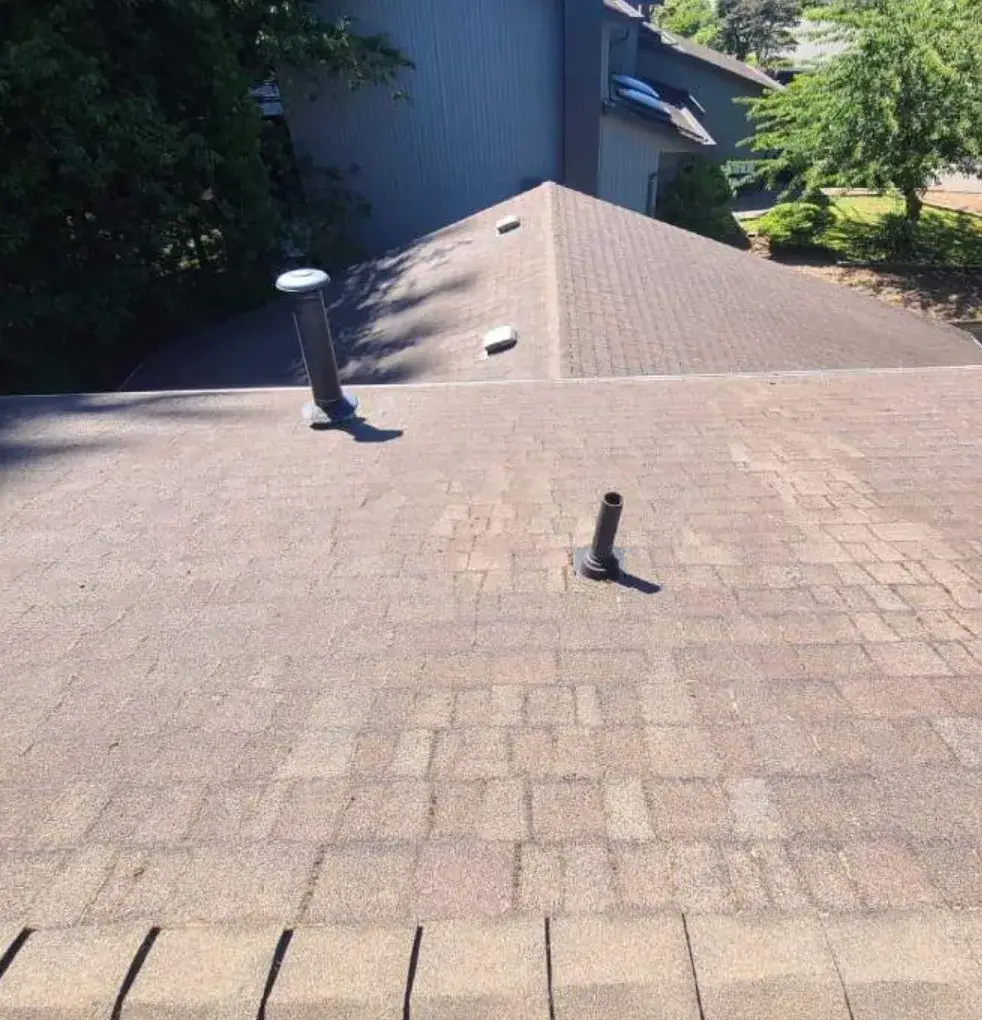
Anything that sticks up through the roof makes a small dam, and moss builds up on its uphill side. Behind a wide chimney there is often a cricket, a little peaked section built to split the water around the brickwork, and it fills with needles. Skylights sit in a raised frame that holds a wet line of debris along the top edge. Plumbing vents come up through rubber boots, and moss grows up against them.
We work around all of these by hand and never put weight on them. Around a solar array we clear the shingles on every side we can reach and keep our tools out from under the panels. Where the flashing at a chimney or skylight is lifting, or a vent boot has split, you hear about it before we come down.
The bottom courses and the trough
The last few rows above the gutter stay wet the longest, because everything from higher up drains across them. Moss there tends to be young and patchy, but it creeps under the drip edge if it is left. We finish these starter courses by hand, then lift out of the trough whatever moss fell into it during the work and add it to the bags. Where a rinse helps, it is a low-pressure soft wash. High pressure is never used on asphalt shingles or cedar shakes. Coverings each behave a little differently up here, and cedar shake and tile or metal have their own pages.
Sheds, shops and carports
Acreages out toward Hilliers often come with a shop, a woodshed or a carport as well as the house. A workshop or woodshed under the trees can be greener than anything else on the property. These roofs are often low-slope, and some older sheet or rolled roofing will not take a person’s weight, so we work them from the ladder or the edge. Tell us about them when you book, and we will look at them on the same visit.
When we come down
You get a plain account of the roof, part by part: which face carried the most, whether the valleys were holding water, and what we saw at the chimney, the skylights and the vents. A thin film of roots will still show on the heavier slopes. If you chose a treatment and the weather allowed one, it has gone onto that film; either way it weathers off over the following weeks of rain. How to slow the moss coming back is covered on moss treatment and prevention. For a quote in Parksville, or anywhere from Nanoose Bay up to Bowser, send us the address and mention any outbuildings.
The work
On the job
Why choose us
Why choose us for roof demossing
Five years on moss
We have been taking moss off roofs since 2021, on shoreline houses near the Strait and on acreage roofs under tall fir inland.
Covered for work at height
We are insured and WCB-registered, and that is in place before anybody sets a ladder against your eaves.
Owned and run locally
Parksville Moss Removal is locally owned and operated. The people who quote your roof are the people who come out to demoss it.
A guarantee you can use
If any part of the work is not right, call us. We come back and make it right.
Got questions?
Roof demossing: what people ask
We have solar panels. Can you still demoss the roof?
Yes. We clear the shingles around the array and along its edges by hand. We do not stand on panels, lean on them, unbolt them or push tools in under the racking.
Moss growing in the shade under a panel cannot always be reached without lifting it. Where that is the case, we leave it and tell you rather than force a tool in there.
There is moss on the chimney itself. Is that part of the job?
Moss on the roof side of the chimney, along the flashing and in the cricket behind it is cleared as part of the demoss. Growth on the brick or block above the roofline is lifted with a soft brush where we can reach it safely.
Loose mortar, cracked crowns and lifting flashing are repairs. We point them out, but we do not do repair work.
Can you demoss the shop and the garden shed while you are here?
Yes. Tell us about the outbuildings when you ask for a quote, and we will price them with the house. Low-slope roofs and older sheet roofing are not always safe to stand on, so some of that work is done from the ladder.
Is summer a bad time for this, with the moss gone brown and dry?
Not at all. Brown moss is still rooted, and a dry roof is safer to stand on. Dry moss is brittle and crumbly, so it comes off in smaller pieces and takes more sweeping on the ground afterwards, but it comes off.
Why do you start up at the ridge instead of at the gutter?
Moss and grit loosened up top slide down the slope. If the bottom courses were done first, they would be covered again by the time we finished. Working down the roof also moves the scraper the same way the shingles overlap, so it slides over each edge instead of lifting it.
What sets the quote for a demoss?
How much roof there is, how steep and high it is, how many valleys, dormers and fittings it has, how thick the moss is, and how easy it is to set a ladder. A plain rancher in the open and a two-storey house under fir can be very different jobs. The quote is free, and we give it after looking at the roof.
Will you go up on our skylights or the roof vents?
No. Skylights, plastic vent hoods and pipe boots are never used as a step or a handhold. We reach around them, brush the moss away from the frame or the collar, and keep our weight on the roof itself.
Roof Demossing in Parksville and Oceanside
Tell us the address and we will get you a price.