
Strata and commercial
Strata, Resort and Commercial Roof Moss Removal in Oceanside
For strata councils, property managers and business owners around Parksville and Qualicum Beach: every roof on the site cleared, planned around the people who live and work below.
Customer reviews
What customers say
They are efficient, hardworking, and reliable. I’ll definitely call them again for other services. Highly recommended!
Great customer service, and they came quickly..will be using again for sure
They do a great job and provide great customer service! They are always reliable. Thank you,
Why us
Why customers love our service
And why you will get the best moss removal service in Parksville!
Fast and efficient moss removal
We arrive on the agreed day, finish every slope we quoted for, and leave the yard as tidy as we found it.
Clear and quick communication
Calls and texts get answered, the price is settled before work begins, and afterwards we tell you how the roof looked.
Five-star reviews
Homeowners rate our crew five stars, review after review.
Clearing moss since 2021
Five years on Oceanside roofs of every kind: asphalt, cedar, tile and metal, plus the paving beneath them.
- A walk round the property with whoever holds the keys, before we name a figure
- A written quote that puts each building and each roof type on a separate line
- Plain-language notices for owners, tenants or guests, worded for you to send
- Needle mats and moss lifted out of roof drains, scuppers and the gutter trough
- Walkways, patios and parking stalls under the work swept clean before we leave each day
- Photos and a short note for every roof, for the council minutes or the owner's records
Before and after
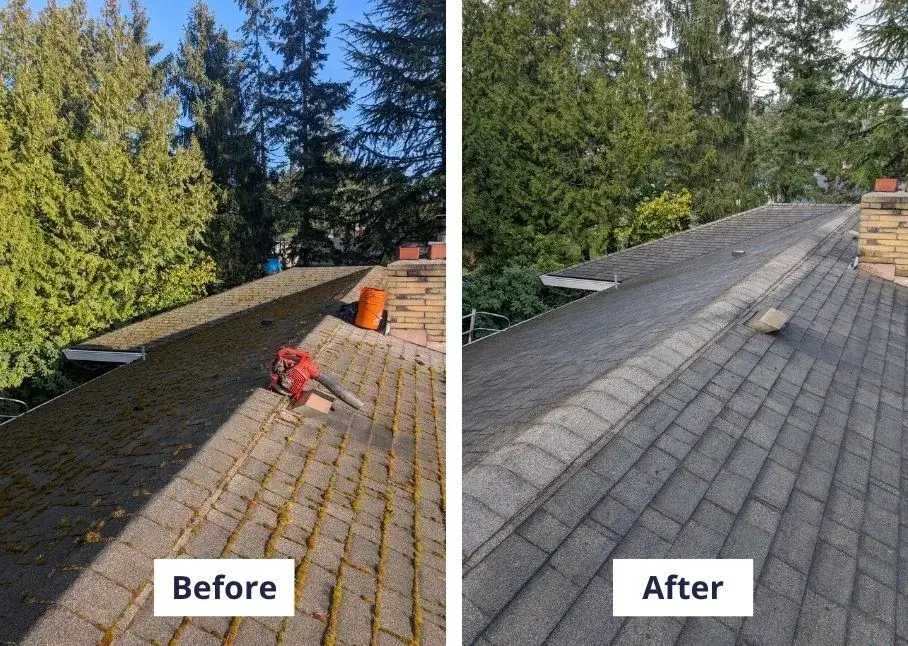
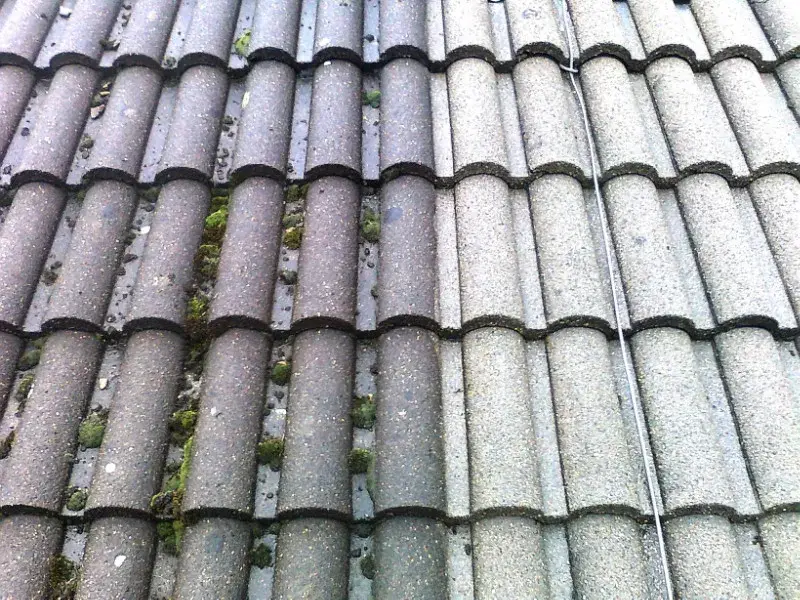
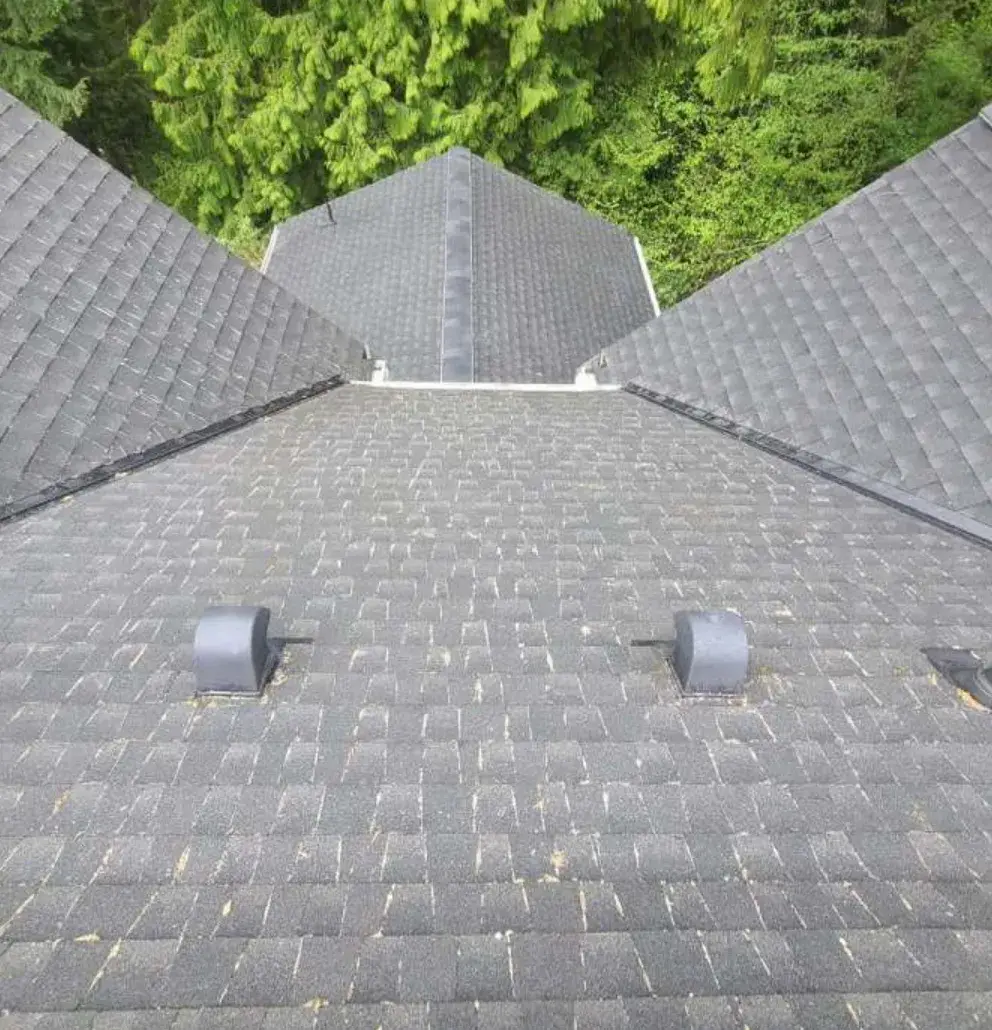
One roof, before and after
Before and after, joined in a single image.
Most of the multi-unit roofs we work on around Parksville and Qualicum Beach fall into three groups. There are townhouse stratas where most owners would rather leave ladder work to someone else. There are resort and rental buildings near the beaches, where guests are under the eaves for much of the year. And there are small commercial buildings along Highway 19A: a plaza of shops, an office, a hall. The moss is the same moss that grows on any house. What changes is who has to agree to the work, who is walking underneath it, and what paperwork comes out the other end. This page covers that part of our roof moss removal work.
Three kinds of client, three sets of needs
- A strata council. Volunteers, often with one member doing the legwork. They need a figure they can explain to the other owners, set out so it can be split if the money is short.
- A property manager. Several sites, little time, and a duty to keep owners informed. They need one contact, notices they do not have to write, and a record for each building.
- A business owner or resort operator. Customers or guests on site most days. They need the work fitted around trade, with doors and paths open the whole time.
We set up each job around whichever of those you are.
What we look at on the site walk
We walk the whole property before quoting, because a complex is rarely one kind of roof. A typical Oceanside strata has sloped asphalt on the units, perhaps a flat-roofed clubhouse or garage block, and a row of skylights nobody remembers until they are up there.
The things that decide how heavy the moss is, and how long the job takes, are mostly on the ground. We note which roofs sit in the shade of the Douglas fir and western red cedar along the back of the lot, and which face north. We look for bigleaf maple, whose fall leaves pack into roof drains, and arbutus, which drops bark and leaves in summer when you might expect the roof to stay clean. Then we check access: how close the units are to each other, where the shrubs are, and where a ladder can stand without crushing a garden bed.
How it works
How Booking a Building Works
Four steps, built around a manager or strata council. Describe the site, approve the price, and residents stay off the ladders.
Describe the site
Start with the basics.
The address, how many buildings and storeys, the roofing material, and anything that affects the day: trees, access, parking, or residents who need notice.
Approve the price
Each quote is worked out for one site.
Total roof area, steepness, height, material, the amount of moss and the scheduling involved set the figure. It is free, and settled before work begins.
The moss comes off
Residents and staff stay on the ground.
Scrapers and brushes clear each roof, treatment goes on where it helps, and the bagged moss leaves with us. Washing is a low-pressure soft wash; asphalt shingles and cedar shakes never see high pressure.
Hear what we saw
One report, to whoever booked us.
Curled tabs, flashing pulling loose, or one building greening up faster than the rest: you get the details and decide what follows.
Done.
- You describe the site.
- You approve a free quote.
- We clear the moss from every roof.
- The maintenance list gets one line shorter.
Want the green gone from the buildings? Ask for a free quote and leave the climbing to our crew.
Flat and low-slope sections: drains come first
A membrane roof drains through a few outlets, so on any flat section we start at the drains and scuppers and lift out the needle mats and moss that have built up around them. Once the water has somewhere to go, we work back across the surface with plastic scrapers and stiff brooms. Membrane cuts easily, so nothing with a metal edge goes on it, and neither does high pressure. Where moss has grown down into gravel ballast, we pull it out by hand and rake the stones back over any bare patch, because exposed membrane ages faster in the sun. The sloped units get the treatment described on our asphalt shingle page, with the order of buildings planned so the work moves across the site in one direction.
Planning around the calendar
Moss here greens up and spreads through the wet months, from about October to April, and dries out and browns over the summer. Dry moss comes away cleanly and wet moss smears, so the roofs themselves favour the drier part of the year. Your calendar matters just as much. A strata usually approves its budget at the annual general meeting, so the quote needs to be in hand beforehand. A resort usually wants the work done before summer bookings fill up. We plan the dates with you, and when rain pushes a building back we tell the contact straight away so the notices can be changed.
The work
On the job
The moss will come back, so plan the next round
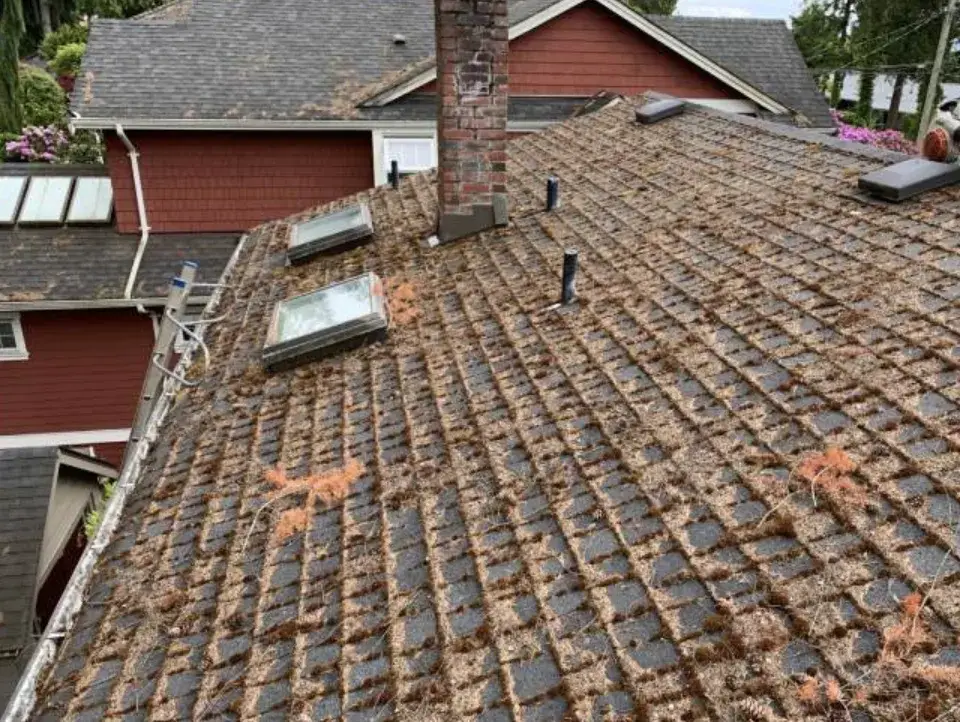
Clearing a complex is not a one-off. The trees around the property stay, and so does the shade. A treatment after the clear-off slows the regrowth, but the honest plan for a council is a yearly look at every roof and a clear-off for the ones that need it. Phasing helps here. If the shaded north-side buildings get done one year and the rest the next, the cost is spread out and no roof goes too long. Where the problem is dark streaking and lichen rather than thick moss, our roof cleaning page covers the low-pressure soft wash we use for that.
What ends up in your file
When the work is done, the contact gets a short write-up for each building, with photos: how heavy the growth was, what we cleared from the drains, and anything we noticed that a roofer should look at, such as a cracked boot around a vent or a lifted shingle. We do not do roof repairs. We point problems out so the council or owner can decide what to do. Moss that drops into the gutters along the way is cleared from the trough and bagged with the rest. Our insurance and WCB registration details are available for the file. We have been clearing moss since 2021, and if anything we did is not right, we come back and make it right.
We look after strata and commercial roofs across Parksville, Qualicum Beach, French Creek and Nanoose Bay. Contact us to book a walk round your property.
Why choose us
Why choose us for commercial & strata roofs
One person to call
The manager or council contact deals with the same person from the first site walk to the final notes.
Quotes that survive a meeting
Each building is its own line, so the council can approve the worst roofs this year and leave the rest for next.
Soft tools on soft roofs
Membrane, shingle or metal, the moss comes off with plastic and bristle. Washing is a low-pressure soft wash, and shingles never see high pressure.
Covered for the work
We are insured and WCB-registered. If a roof is not right after we finish, we come back and make it right.
Got questions?
Questions from councils, managers and owners
Our AGM is coming up. Can we have a quote to put in front of the owners?
Yes. Tell us the meeting date when you first get in touch. We walk the property, then send a written quote that lists every building separately, with a line on how much moss each roof is carrying.
If the budget will not cover the whole complex this year, the quote makes it easy to see which roofs should go first and which can wait.
A lot of our owners are retired. Will anyone have to climb, or shift heavy things?
Nobody in the complex goes up a ladder. All the climbing is ours. On the day a building is done we ask, through the manager, for cars to come out from under the roof edge and for light patio items to be moved back from the eaves.
If an owner cannot move a heavy planter or a bench, tell us which unit. We plan that corner around it rather than asking them to struggle with it.
We run a waterfront resort. Can the work be kept away from our guests?
Mostly, yes. Send us the occupancy picture and we will plan the roofs building by building, starting with whatever is empty. The quieter months either side of summer often suit this work best. Entrances stay open, and moss that falls on paths is swept up as we go.
Is moss on our flat roof doing harm, or does it just look untidy?
On a low-slope roof it is more than looks. Moss holds water against the membrane, roots into gravel ballast, and drifts toward the drains, where a blocked outlet can leave water standing across the roof.
We clear the outlets first and tell you if the standing water looks like a drainage or slope problem, which is a job for a roofer rather than for us.
If you treat the roofs afterwards, can we skip a few years?
Treatment slows the regrowth. It does not stop it, and the firs and cedars around most complexes are not going anywhere. Most councils do best with a quick look at the roofs each year and a clear-off when one needs it. Our moss treatment and prevention page explains what the treatment does and does not do.
Who do you deal with, the manager, the council or the owners?
Whoever the strata or the business names as the contact. Usually that is the property manager, or one council member on a self-managed strata. We send quotes, notices and the finished notes to that person, and we only talk to individual owners about the day's arrangements at their own unit.
Commercial & Strata Roofs in Parksville and Oceanside
Tell us the address and we will get you a price.